
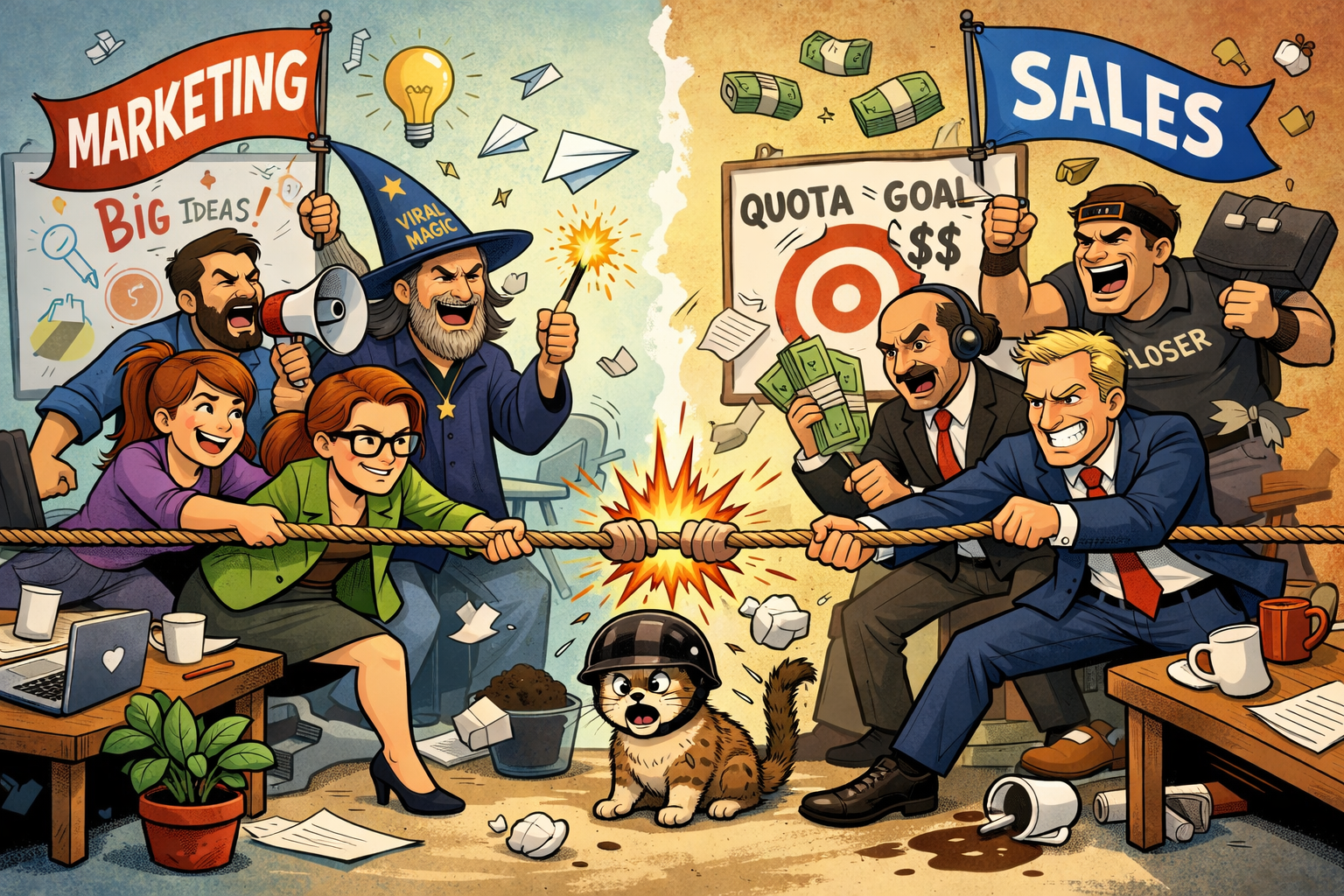
Selling is often described as one of the world’s oldest professions. Yet few professions have had to reinvent themselves as frequently, or as fundamentally, over the last hundred years. Each shift in the marketing paradigm has reshaped how selling is practised, perceived, and valued. Today, as businesses operate in a digitally saturated, data-rich environment, an old question demands a fresh look: Are marketing and sales still two distinct functions, or have they finally met?
From Distribution to Persuasion
In the early twentieth century, selling was largely about distribution. In supply-constrained markets, products sold because they existed. Salespeople were order takers, not strategists. As competition intensified, selling became persuasive. The sales orientation dominated, celebrating closing skills, quotas, and individual performance. Marketing, meanwhile, began to take shape as a distinct discipline, concerned with demand creation rather than deal closure.
This division hardened with the rise of the marketing concept. Marketing assumed strategic primacy through segmentation, targeting, and positioning. Sales was tasked with execution. The implicit promise was seductive: if marketing did its job well, selling would become easier, even invisible.
The Relationship Turn, and Its Limits
Late twentieth-century thinking softened this divide. Relationship marketing reframed customers as long-term assets rather than one-time transactions. Sales roles expanded into key account management and solution selling. In India’s B2B sectors, capital goods, IT services, industrial chemicals, salespeople were expected to understand client processes, not just pitch products.
Yet convergence remained incomplete. Marketing “owned” insights; sales “owned” customers. Incentives diverged. Marketing optimised for reach and leads; sales for revenue and closure. The fault lines were structural, not philosophical.
Digital India Changes the Rules
The digital shift has upended this fragile balance. Today’s Indian buyer, whether a fintech SME customer, a SaaS procurement head, or an insurance policyholder, arrives informed, opinionated, and comparison-ready. Research suggests that a majority of buying decisions are shaped before a salesperson enters the conversation.
In fintech, platforms like payment gateways or lending apps rely on digital onboarding, content-led education, and in-app nudges, classic marketing tools, to drive adoption. Sales intervenes selectively, often to resolve trust gaps or regulatory concerns. In SaaS, freemium models and product-led growth blur the boundary further: is a conversion driven by marketing, product design, or sales intervention?
Insurance offers perhaps the clearest illustration. Traditionally sales-led, the sector now depends heavily on digital awareness, comparison platforms, and data-driven targeting. Yet mis-selling concerns persist, reminding us that trust, judgment, and ethical persuasion cannot be fully automated.
Technology Has Converged Faster Than Organisations
CRM systems, marketing automation, AI-driven lead scoring, and analytics platforms have erased operational boundaries. A digitally nurtured lead handed to sales raises a simple but revealing question: where does marketing end and sales begin? Increasingly, it does not matter.
What does matter is that organisational structures and incentives have not kept pace. Marketing is often rewarded for volume; sales for value. The result is friction at precisely the moment collaboration is most needed.
The Human Element that Matters
For all the promise of technology, selling remains deeply human. Negotiation, empathy, reassurance, and sense-making are critical, especially in high-involvement Indian contexts such as enterprise software, financial services, or healthcare. Marketing can scale messages, but sales operates at depth.
The danger lies in assuming that digital tools can replace relational competence rather than augment it.
Towards a New Compact
The future does not lie in merging marketing and sales into a single monolith. It lies in redefining their interface around the customer journey. Outcomes, not functions, must be co-owned. Marketing must be accountable for lead quality and downstream value. Sales must be fluent in digital signals and content-driven engagement.
For business schools and corporate leaders alike, the implication is clear. Are we training sales professionals as sense-makers rather than closers? Are marketers evaluated on revenue impact, not just visibility? Are incentives aligned to reward collaboration rather than functional silos?
Has the Twain Met?
Perhaps the better answer is this: marketing and sales are no longer parallel lines. They intersect continuously and often uncomfortably, across the customer journey. In digital India, selling is increasingly marketing-led, and marketing is increasingly sales-aware.
The real challenge is not convergence. It is coherence.
And those organisations that get this right will not merely sell more. They will sell better: more responsibly, more sustainably, and a great deal more intelligently.
 Markets and Conversations